The History of United States Patent Models and the Rothschild Petersen Patent Model
Museum
-
1790
-
With the Patent Act of 1790 the United States Patent Office was created.
Secretary of State Thomas Jefferson, Secretary of War Henry Knox, and Attorney
General Edmund Randolph headed the three-member Patent Commission. They
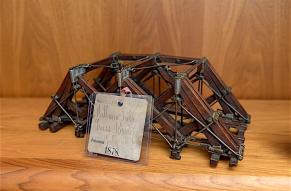
established the requirement that a working model of each invention be produced
in miniature.
The first US patent was granted in 1790 to Samuel Hopkins of Pittsford, Vermont
for an improvement in the "making of Pot Ash by a new apparatus & process." -
1793
-
The original Patent Law was revised. A simple registration system was
implemented whereby anyone who applied and paid a $30 fee was granted a patent.
The revision of the Law also eliminated the Patent Board. The act of granting
patents fell to a clerk in the Department of State. James Madison, Secretary of
State, created a separate Patent Office within the State Department. In May
1802, he appointed Dr. William Thornton its first superintendent.
-
1810
-
The Patent Office moved from the Department of State to Blodgetts Hotel. For
the first time many of the models were put on public display. It became a local
custom on Sundays to stroll through the rooms and see what new models were
there.
-
1823
-
For the first time, an attempt was made to record and keep a list of the
then-existing models, which totaled 1,819.
-
1836
-
The Patent Act of July 4, 1836 reestablished the examination system of 1790.
Models were once again required by the Commissioner. "The model, not more than
12 inches square, should be neatly made, the name of the inventor should be
printed or engraved upon, or affixed to it, in a durable manner." At first the
application fee was $30 for United States citizens, $500 for British subjects,
and $300 for any other alien.
-
-
On July 13, 1836, a numbering system for the patent models was
instituted instead of the previous practice of using names.
Patent number 1 was issued to Senator John Ruggles of Maine
(head of the committee to draft the new patent law).
On December 15, 1836, there was a fire in the Patent Office. The entire building
burned to the ground. All records and most of the models were destroyed.
Congress appropriated $100,000 for the restoration of 3,000 of the most
important models. -
1842
-
New and original designs became patentable. The first design patent was granted
to George Bruce of New York City for a typeface.
-
1870
-
Congress abolished the legal requirement for models; however, the US Patent
Office kept its requirement for models until 1880. Some models were still being
submitted at the turn of the century.
-
1876
-
The public was barred from seeing the models because of lack of space.
-
1877
-
A second fire in the Patent Office of September 24, 1877 destroyed 76,000
models. Congress appropriated $45,000 for their restoration.
-
1880
-
The model requirement was deemed impractical and the law was changed to permit
models only when required by the Commissioner. 246,094 patents had been issued
by 1880 and perhaps 200,000 were represented by models.
-
1893
-
The models were moved out of the Patent Office and placed in storage.
-
1908
-
Congress decided to sell all models. An auction of some 3,000 models that had
failed to receive patents sold at that time for $62.18. The remaining estimated
150,000 models were stored, finally ending up in an abandoned livery stable. It
was estimated that $200,000 had been spent in moving and storing the models
from 1884 to 1925.
-
1910
-
One millionth patent issued. The models were stored in barns and basements for
almost 20 years until a sale was finally organized during Calvin Coolidge's
presidency.
-
1925
-
On February 13, 1925, not wanting to continue to pay the cost of storage,
Congress appropriated $10,000 to do away with the models one way or another.
The Smithsonian Institution received an additional 2,500 models.
On December 3, 1925, the models were sold at an auction to philanthropist Sir
Henry Wellcome. It is believed that he intended to establish a Patent Model
Museum. His plans dissolved with the stock market crash of 1929. He died in
1936 at the age of 82 without realizing his ambition. -
1936
-
The trustees of Wellcome's estate sold the models for $50,000 to Broadway
producer Crosby Gaige. He in turn sold out to a group of businessmen for
$75,000. This group formed the American Patent Models, Inc.
-
1940
-
American Patent Models, Inc. declared bankruptcy. 1941 The models were acquired
by O. Rundle Gilbert, an auctioneer, in a bankruptcy auction at Foley Square in
New York City for $5,000 and moved to his home at Garrison-on-the-Hudson, New
York.
Gilbert held many auctions and thousands of the models were sold. On a number of
occasions, Gilbert entered into various deals to sell the entire collection,
but it wasn't until 1979 that a deal was actually completed. -
1979
-
Cliff Petersen, a designer and inventor within the aerospace industry,
purchased from Gilbert his remaining 800 crates - some of which had not been
opened since the original packing in 1926 - for $500,000. Petersen began
collecting patent models from Gilbert in 1973.
-
1989
-
Petersen donated 30,000 models and one million dollars to the United States
Patent Model Foundation. He kept approximately 5,000 models that were in his
personal collection.
Featured in a 20/20 expose, the United States Patent Model Foundation was
plagued by a series of problems. Models were sold in antique shops, flea
markets, and auctions. Petersen attempted to have the models returned to him,
but the bulk of the models remained trapped amid much legal wrangling. -
1996
-
In January and November, two auctions of patent models from Petersen's personal
collection were held at Christie's in New York City.
-
1998
-
Alan Rothschild created the Rothschild Petersen Patent Model Museum. A
significant segment of the patent models represented in the Museum were
purchased from the private collection of Cliff Petersen. In addition, Mr.
Rothschild purchased all 82 models comprising the Patent Model Museum in Fort
Smith, Arkansas, and added them to the Rothschild Petersen collection.
-
2001
-
In July 2001, The Rothschild Petersen Patent Model Museum(RPPMM) received
museum status in New York State and official designation as a 501-C-3
corporation.
In October 2001, patent models from the RPPMM formed the basis for the U. S.
Patent and Trademark Office's exhibit, "School Days." -
2002
-
Donald Grant Kelly became the Executive Director/ CEO of the RPPMM/IC
(Rothschild Petersen Patent Model Museum/ Invention Center) in February 2002.
Don Kelly is recognized throughout this country as a champion of inventors and
entrepreneurs. An intellectual property consultant and registered patent
practitioner, Kelly served for over three decades with the U.S. Patent and
Trademark Office (USPTO). He served as senior assistant to two commissioners
and directed the operation of a variety of patent examining divisions. He was
founding director of the Office of Independent Inventors programs and was the
principal architect of the educational outreach program, "Project XL."
Following his federal service, he was the CEO of the prestigious Academy of
Applied Science, a non-profit educational and technological research institute.
Currently, as CEO of Intellectual Asset Management Associates(IAMA), Don serves
as intellectual property consultant, expert witness, registered patent
prosecutor and technology broker.
In February 2002, the patent models were the centerpiece in an exhibit at the
USPTO, entitled, "Icons of Innovation."
In August 2002, the RPPMM hosted the 7th Annual Independent Inventors
Conference, ICON 2002. Cosponsored by the RPPMM, the USPTO, the United
Inventors Assoociation, and Onondaga Community College, the conference
attracted inventors and aspiring inventors from across the country and Canada.
With a keynote address by the inventor of the medical respirator, Dr. Forrest
Bird, the two day conference was a resounding success. An exhibit of over 200
patent models from the Central New York area served as a backdrop to the
conference which was held at Onondaga Community College in Syracuse, New York. -
2003
-
In May 2003, State University of New York(SUNY) Chancellor Robert King and
The RPPMM/IC entered into a partnership to establish a National Patent Model
Museum and Invention Center. Identifying three campuses ( Cortland,
Morrisville, and Oneonta) to play leadership roles, they have begun to work
together to develop programs.
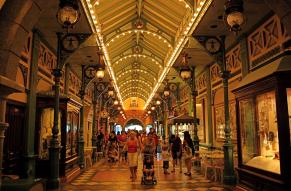
Recently Disney Imagineering renewed, for an additional three years, an
agreement to continue to have fifty three models on display at EuroDisney.
The models have been the subject of stories on CBS Sunday Morning, the History
Channel and Home and Garden TV.
It is the hope that the RPPMM/IC will shortly become a bricks and mortar
reality - a physical building that not only will house the patent models, but
also serve as a source of inspiration to inventors and innovators worldwide.
 |
|
| | |
| | |
Copyright © 2001 Alan Rothschild. All
rights reserved.
|
 |
 |